Blog
How Google AI Mode Ads Are Changing B2B Lead Generation
09 Sep 2026Techwaresoft7 min read
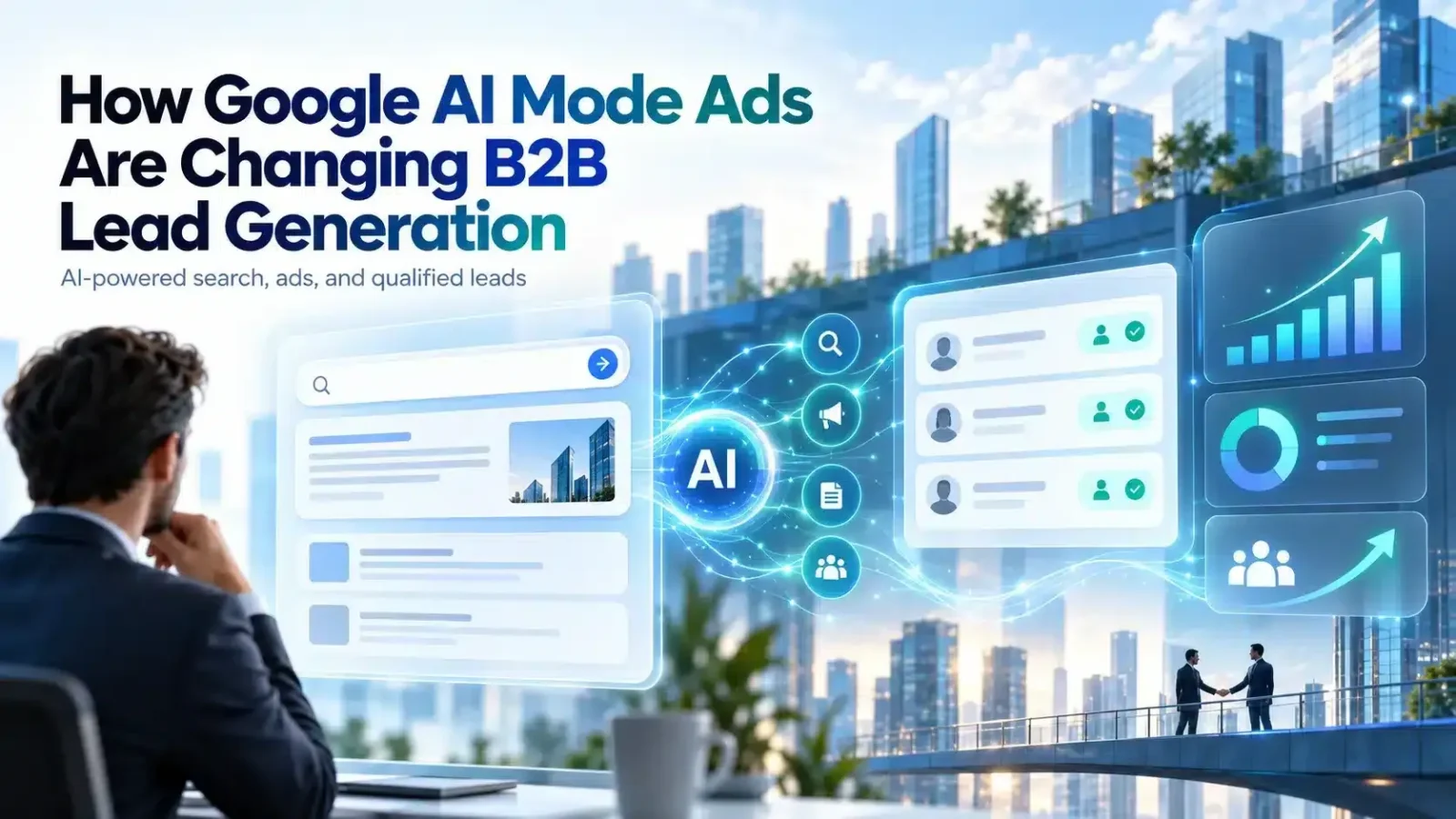
Google Search is becoming more conversational. Instead of entering a short phrase, users can explain a problem, add requirements, compare options, and ask follow-up questions through AI Mode. For B2B companies, this creates a different lead generation environment. A prospect researching CRM implementation, enterprise software, cybersecurity, or digital Marketing can now describe an entire business need in one search. Google is also testing advertising formats designed specifically for these AI-assisted journeys, bringing paid visibility closer to the research and evaluation stage of a buying decision.
What Is Changing With Ads in Google AI Mode?
Google has been testing ads inside and around AI Mode responses rather than limiting advertising to the traditional search results layout. At Google Marketing Live in May 2026, Google introduced two AI Mode ad concepts built with Gemini: Conversational Discovery ads and Highlighted Answers. Both are designed to provide relevant information alongside the advertiser’s creative and remain labeled as Sponsored. (Source)
Conversational Discovery ads can respond more closely to the question a user is asking. Highlighted Answers can place an eligible sponsored recommendation within a list of relevant options generated during an AI Mode search.
This matters because AI Mode searches can carry much more context than traditional queries. Google reported in May 2026 that AI Mode had passed one billion monthly active users globally, while AI Mode queries had more than doubled every quarter since its U.S. launch. Google has also reported that AI Mode queries tend to be longer and more exploratory than traditional searches. These figures describe overall AI Mode behavior and should not be interpreted as B2B advertising performance data. (Source)
Traditional Search Ads vs. AI Mode Advertising
| Area | Traditional Search Ads | Emerging AI Mode Ads |
| User behavior | Often starts with a shorter keyword query | Supports complex questions and follow-up searches |
| Ad context | Closely connected to the current search query | Can use broader conversational context |
| Experience | User usually clicks through to a landing page | Ads may become part of the research conversation |
| Matching | Keywords, broad match, audience, and other signals | Greater emphasis on AI-powered matching and intent |
| Lead journey | Often moves quickly from ad to website | May help users evaluate a solution before taking action |
| Availability | Established Google Ads environment | Some AI Mode formats remain in testing or phased rollout |
The final point is important. Businesses should not assume that every new AI Mode advertising feature is currently available in every country or Google Ads account. Some of these experiences are still being tested or introduced gradually.
The Bigger B2B Opportunity: Business Agent for Leads
One of Google’s most relevant 2026 announcements for lead generation is Business Agent for Leads.
Google describes it as a Gemini-powered brand agent that can appear directly inside an ad. A user can select a Chat option and ask questions, with responses based on information from the advertiser’s website. This creates an alternative to immediately sending every prospect to a traditional lead form.
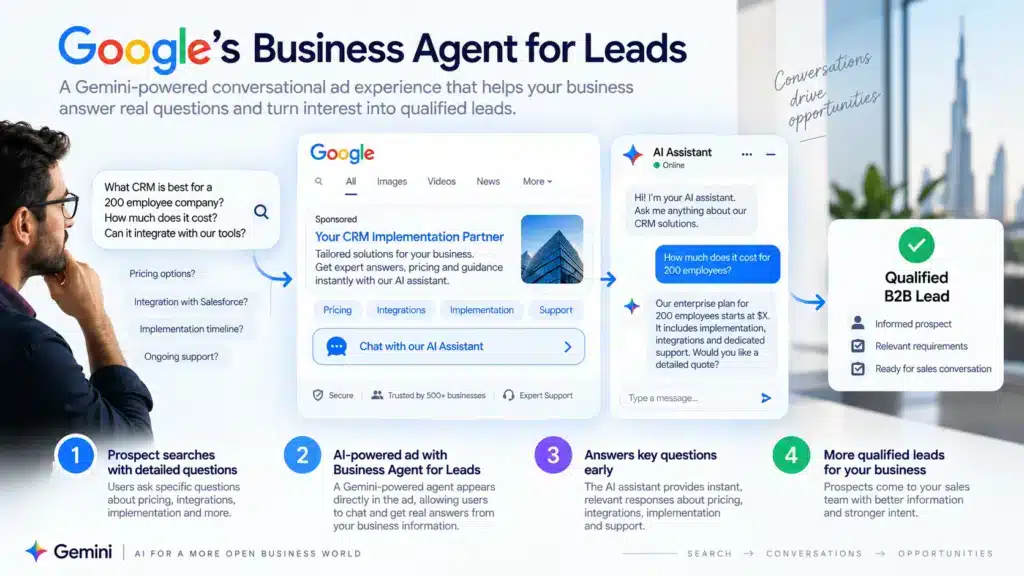
Google later confirmed that Business Agent for Leads was being tested in beta in India, including a test involving upGrad. This is an important distinction because businesses in other markets should verify availability rather than assume the feature is already accessible in their accounts. (Source)
For B2B marketing, the concept could be significant. Prospects often need answers about pricing models, integrations, implementation, compatibility, support, or service scope before contacting sales.
A conversational ad experience could help answer some of those early questions before a sales conversation begins. Businesses exploring similar conversational experiences may also need stronger website architecture, data integrations, and AI development capabilities to support AI-driven customer journeys outside paid advertising.
Keywords Still Matter, but Matching Is Expanding
AI Mode does not mean Google Ads has abandoned Search campaigns.
Google’s AI Max for Search is an optimization layer for existing Search campaigns rather than a completely separate campaign type. Its search term matching can use broad match and keywordless technology, while asset optimization can adjust messaging and help select relevant landing pages based on user intent. (Source)
For companies already investing in PPC, this means campaign performance may increasingly depend on the quality of website content, conversion data, landing pages, and the signals provided to Google’s advertising systems.
Businesses should therefore review:
- Service pages and landing pages for accuracy and depth
- Clear descriptions of industries, use cases, and solutions
- Conversion tracking beyond basic form submissions
- CRM data for qualified and converted leads
- Search term and landing page performance
- Brand and URL controls when using AI-powered campaign features
Google reports that non-retail advertisers activating AI Max typically saw 14% more conversions or conversion value at a similar CPA or ROAS in its internal 2025 data. This is Google’s aggregate result and should not be treated as a guaranteed outcome for every B2B campaign. (Source)
Why Lead Quality Becomes More Important
More reach is useful only when the leads are relevant.
This is particularly important in B2B because a completed form is often only the beginning. A lead may still need qualification, meetings, demonstrations, proposals, procurement approval, or negotiation before becoming a customer.
Google’s guidance on enhanced conversions for leads shows how advertisers can connect online lead activity with later offline outcomes. Businesses can use first-party lead information and send later conversion events back to Google when a prospect progresses through the sales process. Google also supports goals such as Qualified lead and Converted lead. (Source)
For B2B marketers, this makes outcomes such as qualified opportunities, sales meetings, pipeline value, and revenue more meaningful than simply trying to generate the highest number of form submissions at the lowest cost.
What Independent Research Shows So Far
AI Mode advertising is still changing quickly, so third-party studies should be treated as snapshots rather than universal benchmarks.
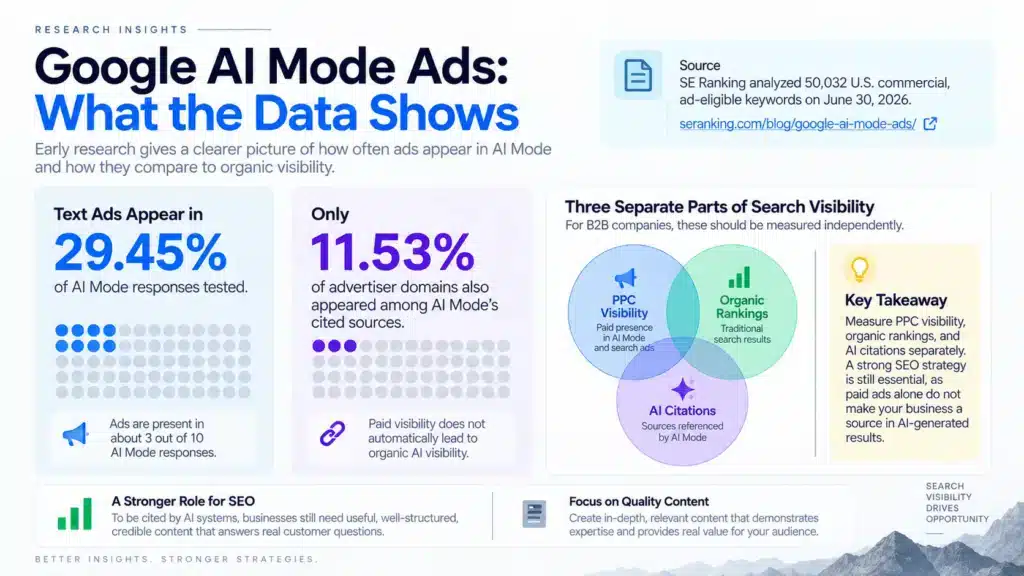
SE Ranking analyzed 50,032 U.S. commercial, ad-eligible keywords on June 30, 2026 and found text ads in 29.45% of the AI Mode responses tested. The same study found that only 11.53% of advertiser domains also appeared among AI Mode’s cited sources for the same searches. (Source)
This suggests that paying for visibility does not automatically result in organic AI visibility.
For B2B companies, the practical lesson is that PPC visibility, traditional organic rankings, and AI citations should be measured as separate parts of search visibility.
This also strengthens the role of SEO in an AI-driven search strategy. Paying for visibility in AI-powered search does not automatically make a company a source that Google’s AI systems reference organically. Businesses still need useful, well-structured, credible content that answers real customer questions.
What Should B2B Marketers Do Now?
Google AI Mode is developing quickly, but businesses do not need to rebuild their advertising strategy around an emerging channel.
The stronger approach is to improve the foundation first: useful website content, accurate service information, strong landing pages, reliable CRM tracking, qualified-lead conversion data, and controlled testing of AI-powered Search features.
Google also provides AI Max experiments, giving advertisers a way to compare AI Max with their existing Search campaign setup before applying it more broadly.
For B2B companies, the goal should not simply be to appear in more AI-generated searches. The focus should be on attracting relevant prospects, providing useful information during the research process, and measuring which leads eventually become real business opportunities.
As AI continues to influence paid and organic search, businesses may benefit from treating SEO, paid advertising, website content, CRM data, and AI capabilities as connected parts of the same customer acquisition strategy.
Frequently Asked Questions
1. What are Google AI Mode ads?
AI Mode ads are advertising experiences Google is developing for its conversational Search environment. Google has announced formats including Conversational Discovery ads and Highlighted Answers, while some formats are still being tested or introduced gradually.
2. Is AI Max the same as Google AI Mode ads?
No. AI Max is an optimization layer for existing Search campaigns. It helps expand search matching, customize creative elements, and connect users with relevant landing pages. AI Mode ads refer to advertising experiences appearing within Google’s conversational AI Search environment.
3. How can B2B businesses measure leads from AI-powered Google Ads?
Businesses should connect advertising measurement with later sales outcomes. Instead of relying only on clicks and form submissions, they can track qualified leads, sales opportunities, converted customers, and other CRM stages that reflect genuine business value.
4. Will AI Mode ads replace traditional Google Search Ads?
Google has not announced that traditional Search Ads are being replaced by AI Mode advertising. AI Mode currently represents an additional search experience, while traditional Search campaigns and Google’s other advertising products continue to operate.

Working on something like this?
Tell us what you are building and who it is for. We will tell you what it takes.