
Understanding the problem
Product discovery
Interviews, workflow reviews and data checks that show what users actually struggle with. You get a clear problem statement before anyone sketches a solution.
Every business has ideas it could build next: a new digital product, an AI feature, a customer app or a different way to serve a market. The expensive mistake is building the wrong one. Techwaresoft helps you find out which ideas are worth building before you commit a budget to them.
We frame the opportunity, build quick prototypes and proofs of concept, and test them with real users and real data. You come away with evidence and a clear decision to build, change course or stop. Our team is based in Sharjah and works with clients across the UAE and abroad.
Specialists and engagement models
Product innovation is the work of deciding what to build next and proving it before you build it in full. It covers new products, new features and new technology. The output isn't a finished system. It's evidence about whether an idea deserves one.
Talk through your idea
Before any technology is chosen, we work out which problem is worth solving. We also ask what would have to be true for a solution to matter commercially. Many ideas fall away at this stage, and that is cheaper than finding out later.
An idea in a slide deck can't be tested. A clickable prototype or a narrow proof of concept can. We build the smallest thing that answers the riskiest question.
Prototypes go in front of the people who would use them and run against your real data. Assumptions meet reality while changing direction is still inexpensive.
Each round ends with a decision to continue, adjust or stop. A well-founded stop is a good outcome when it saves a year of building the wrong thing.
What survives testing leaves with a validated concept, a prototype and a scope for the first real version. It doesn't become a pilot that nobody can take into production.
Six reasons to run a new product idea through discovery and prototyping before committing a full budget to it.
Discuss your ideaA prototype costs a fraction of a full build. If the idea doesn't hold up, you find out before the real spend starts.
Short, timeboxed sprints turn a question into a tested result. Ideas stop sitting in a backlog waiting for approval.
Real customers or staff try the concept before it's built. Their reaction shapes the product instead of arriving after launch.
Each stage ends with evidence and a decision. Leadership signs off on results, not on enthusiasm.
AI, automation or a new platform gets tried on a narrow problem first. You learn what it can do for you without betting the roadmap on it.
Concepts are tested with production in mind. The ones that pass have a realistic path to a real product.
Seven services in four groups, in the order an idea usually moves through them: discover, prototype, test and run it as a sprint.
Interviews, workflow reviews and data checks that show what users actually struggle with. You get a clear problem statement before anyone sketches a solution.
Your candidate ideas weighed by value, feasibility and how ready your organization is to adopt them. The result is a short list and the riskiest assumption behind each.
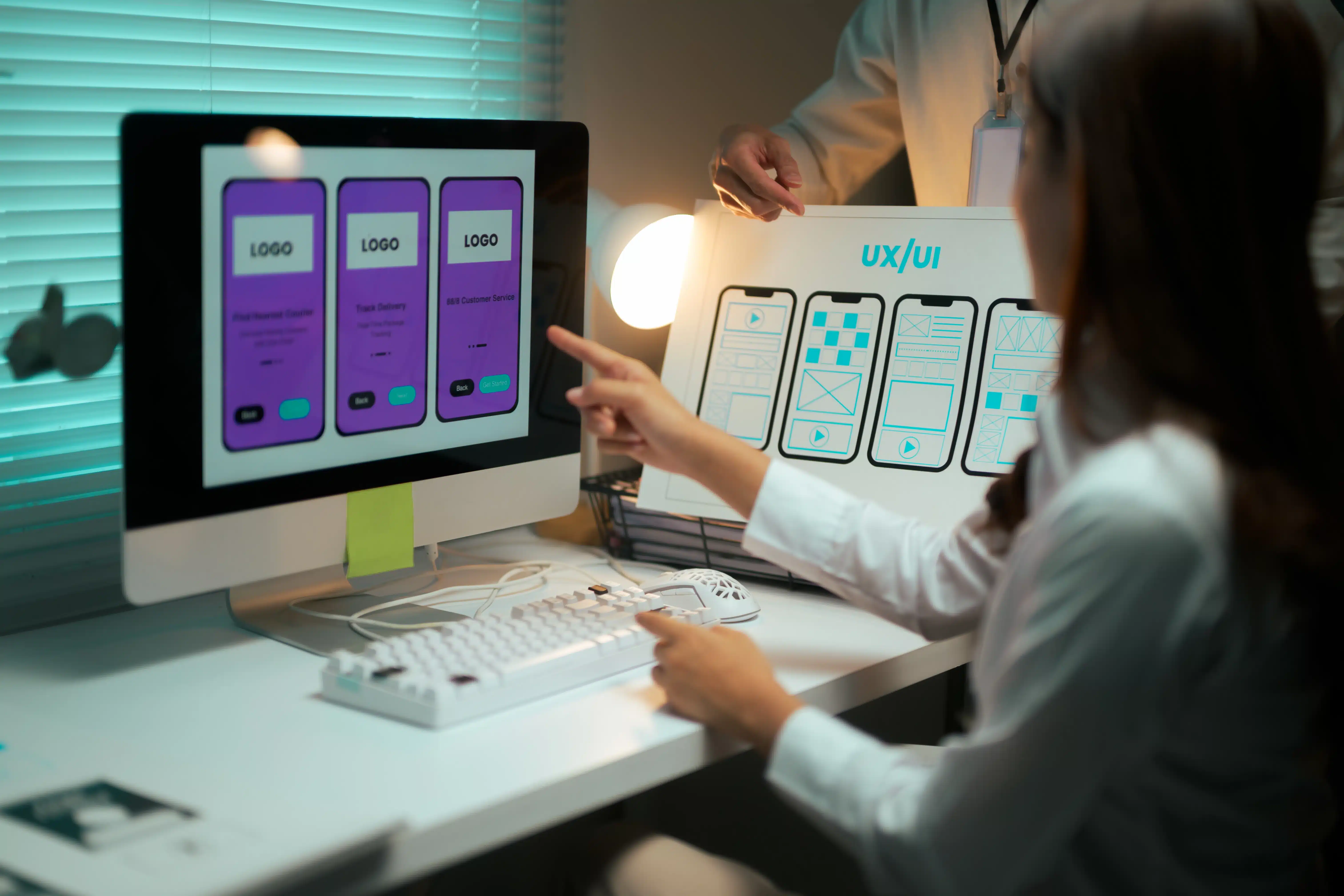
Interactive prototypes of a new product or feature that users can click through. They're built fast enough to change twice in a week.
A narrow working build that answers one technical question. It might test whether a model can read your documents or whether two systems can share data in real time.
A practical assessment of whether a new technology fits your business. We test it against your own use case and data, not a vendor demo.
A validated concept run with a limited set of users or one site. Success measures are agreed in advance, and what production would need is planned before the pilot starts.

A short, fixed-length sprint that takes one idea from framing to a tested prototype. Your team and ours work on it together, and it ends with a decision.
The people who do the work. Each sprint or pilot draws on the few it needs, and the mix changes as an idea moves from paper to prototype.
Framing the opportunity, running workshops and keeping each round tied to a decision.
Interviewing users, mapping journeys and turning ideas into clickable prototypes.
Building working proofs of concept quickly, without the polish a release would need.
Wiring a prototype to real data and real systems so a pilot behaves like the real thing.
Testing app ideas on the devices your users actually carry.
Checking whether an AI idea works on your data before it becomes a project.
Defining success measures and reading what a pilot actually showed.
Standing up pilot environments quickly and cheaply, and tearing them down after.
Making sure a pilot is stable enough that results reflect the idea, not the bugs.
Both have a place. A sprint answers whether something is worth building. A traditional project builds it once the answer is yes.
| Aspect | Innovation sprintTest one idea quickly and decide what to do next. | Traditional projectBuild a defined system to an agreed specification. |
|---|---|---|
| Starting point | A question or an untested idea | A written specification |
| What it produces | A prototype, evidence and a decision | A finished system ready for use |
| Scope | Changes as you learn | Fixed up front and managed through change requests |
| Time to first result | At the end of a short sprint | At the first release, often months in |
| Cost of being wrong | Small, and found out early | Large, and often found out after launch |
| Best suited to | New products, features and technologies | Ideas already validated and ready to build |
Neither replaces the other. Use a sprint while the idea is still uncertain. Once the evidence says build, a properly scoped project is the right route.
Four ways to start, from a single workshop to a standing partnership on your product pipeline.
Choose a starting pointA focused working session with your team to frame the opportunity and pick the idea worth testing first.
A fixed, short timebox that takes one idea to a tested prototype and a decision.
A defined piece of work to prove a technology or run a concept with real users, with success measures agreed in advance.
An ongoing arrangement where we run discovery and prototyping alongside your team as new ideas come up.
Five stages, in this order. Each one can end the work early, and that's by design.
We work out which problems are worth solving and what would have to be true for a solution to matter, before any technology is chosen.
Ideas are turned into something testable quickly, so assumptions meet reality while changing direction is still cheap.
Prototypes are tested with real users and real data, producing evidence rather than opinion.
Continue, adjust or stop, based on what the tests showed and on what production would require.
What survives gets a scope, a plan and the groundwork for a first real version, built by us or by your own team.
We don't have a published innovation case study yet, so we won't describe one. What we can show is how a founder describes working with our team on a new product of their own. An innovation-specific case study will be added here once a client approves one.
Techwaresoft built a learning platform that is intuitive and engaging. The design makes learning drums enjoyable and straightforward, and their attention to user experience really stands out. Our students love the platform.
The method is the same in every sector. What changes is who the users are and which risks matter most.

New digital services for buyers, tenants and agents, tested with real users before they are built.

Patient-facing and internal ideas prototyped with care for privacy and clinical workflow.

New customer journeys and automation ideas tested in a controlled pilot before rollout.

New shopping experiences, loyalty ideas and AI features tried on a small group first.

Tracking, dispatch and field app concepts tested with the people who would use them.

Learning platform and student service ideas prototyped and tried with real learners.

New features and product lines validated before they claim a place on the roadmap.

A founder's idea tested with users before money goes into building it.
Six things that follow from being a software company that also builds what it tests, rather than a consultancy that stops at the slide deck.
Every engagement ends with a tested concept and a clear recommendation, including a recommendation to stop.
Our designers and engineers build products every day, so prototypes reflect what a real build would take.
We run AI and machine learning work ourselves, so AI ideas get checked against your data rather than a demo.
We plan integration, ownership and support before a pilot starts, so a success has somewhere to go.
Your people hold the domain knowledge and keep the capability afterward. We bring method and technical depth.
We're based in Sharjah and work with clients in the UAE, Saudi Arabia, Pakistan, the UK and the US.
Trusted by



The questions businesses ask before testing a new product idea. If yours isn't here, it's the quickest thing to answer on a call.
A tested concept and a clear decision, not a slide deck. That may be a working prototype, evidence supporting a build, or a well-founded recommendation to stop. A stop is a good outcome when it saves a wasted year.
Innovation work decides what is worth building and tests it with prototypes and pilots. MVP development builds and launches the first real version. Many ideas go from one to the other, and some stop at the first, which is the point.
By what is testable, what would matter commercially if true, and what your organization could realistically adopt. Ideas that fail the third test tend to produce impressive pilots that never reach production.
It depends on how many ideas are in scope, how far the prototype needs to go and whether real data or systems are involved. A clickable prototype costs very differently from a working proof of concept. We give a realistic estimate after a short call.
Yes, and it usually works better that way. Your team holds the domain knowledge and we bring the technical and process side. Capability that stays in-house afterward is part of the value.
We decide what production would require before the pilot starts, including integration, ownership and support. A successful pilot then has somewhere to go instead of becoming a demo nobody can run.
Tell us the idea, the problem behind it and who it's for.
We'll come back with how we'd test it, what the first round would cost and what a good result would look like. If it doesn't need testing, we'll say so.