Blog
Can AI Agents Replace Business Software? What the SaaS Shift Means in 2026
11 Sep 2026Techwaresoft5 min read
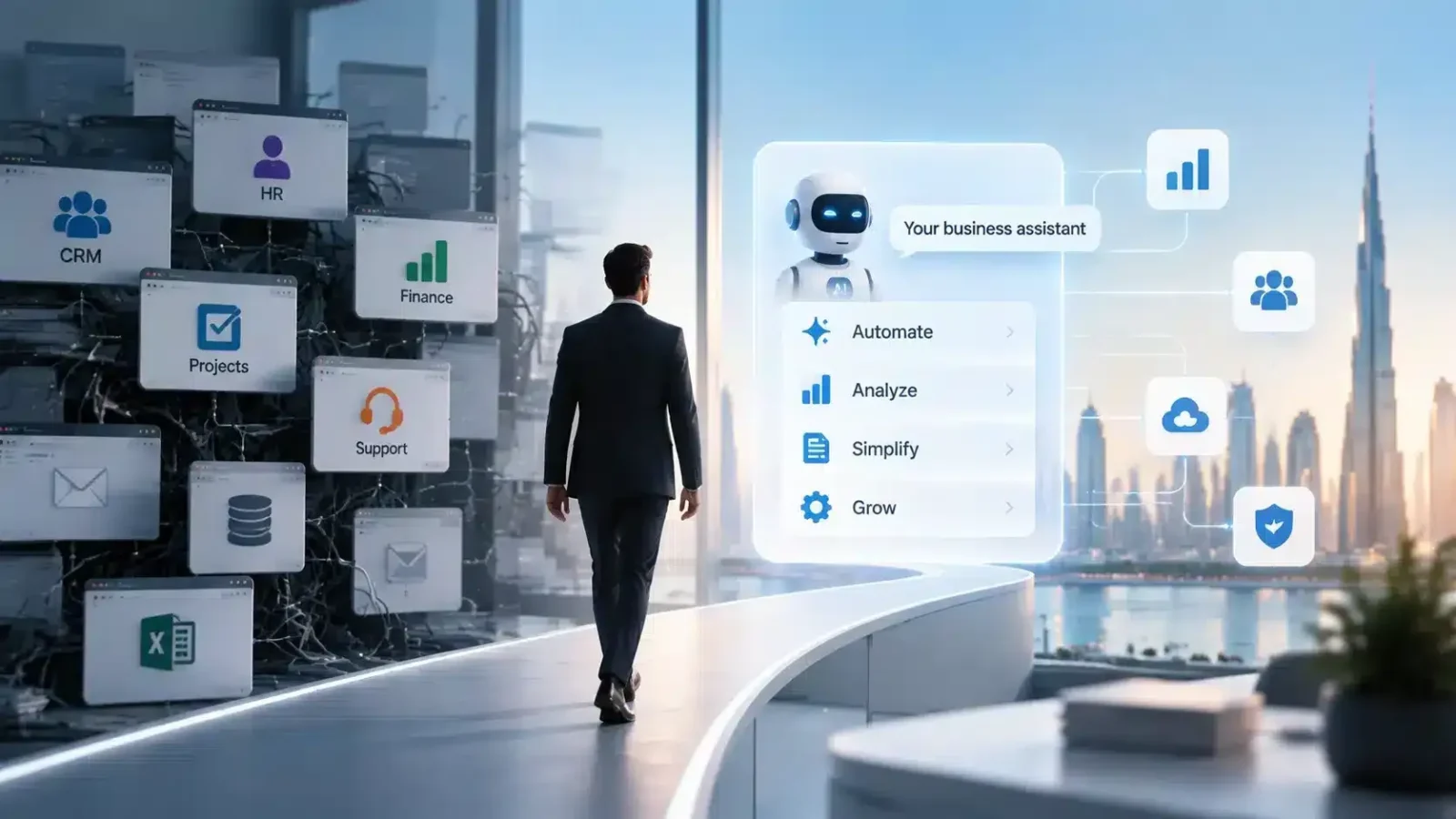
For more than two decades, businesses have relied on SaaS platforms to manage sales, finance, HR, customer support, operations, and communication. Companies adopted different software solutions for different departments, creating a connected ecosystem of business tools.
In 2026, a new question is emerging: Can AI agents replace traditional business software?
AI agents are changing how employees interact with technology. Instead of manually opening multiple applications, searching for information, and completing repetitive tasks, users can increasingly communicate with AI systems that understand goals, access business data, and assist with workflows.
However, this does not necessarily mean traditional SaaS platforms will disappear. The future is more likely to involve AI agents working together with existing business software, improving automation, decision-making, and user experience.
What Are AI Agents in Business Software?
AI agents are software systems designed to understand instructions, analyze information, make decisions within defined boundaries, and complete tasks on behalf of users.
Unlike traditional automation, which follows fixed rules, AI agents can handle more flexible workflows. They can interpret natural language requests, identify patterns, and interact with different systems to complete business processes.
For example, instead of manually creating a sales report, a manager could ask:
Show me this month’s sales performance, identify the biggest opportunities, and suggest follow-up actions.
An AI agent could analyze CRM data, identify trends, summarize results, and recommend next steps.
This capability is creating a shift from software where users operate tools manually toward systems where users communicate their objectives and software helps execute them.
Why Businesses Are Moving Toward AI-Powered SaaS
Traditional SaaS applications solved an important problem: they moved business processes from spreadsheets and manual systems into structured digital platforms.
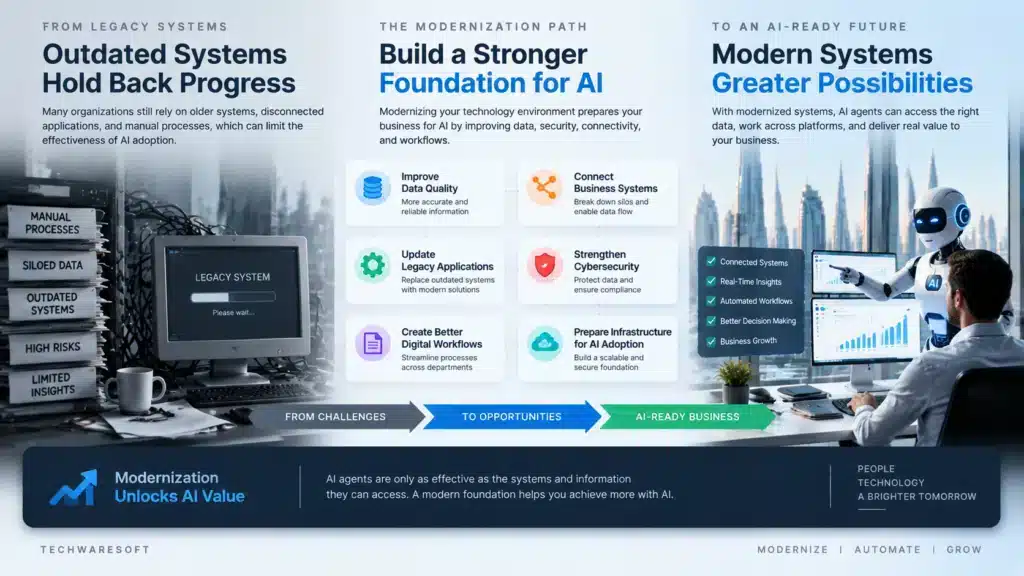
ta, and too many processes that still require human coordination.
AI agents address some of these challenges by helping businesses:
- Automate repetitive administrative tasks
- Analyze large amounts of business information
- Improve customer interactions
- Reduce manual data entry
- Generate insights faster
- Connect information across different systems
This transition is part of broader business Digitalization efforts where organizations are not only adopting new tools but redesigning how work is performed.
AI Agents vs Traditional Business Software
| Area | Traditional Business Software | AI Agent-Based Systems |
| User interaction | Users navigate menus, dashboards, and applications | Users communicate through natural language instructions |
| Task execution | Usually requires manual actions within predefined workflows | Can complete multiple steps based on business objectives |
| Data usage | Users search and interpret available information | AI can summarize, analyze, and provide recommendations |
| Automation | Mostly rule-based automation | More flexible AI-driven workflows |
| Decision support | Reports and dashboards provide information | AI can highlight patterns and suggest actions |
| Human involvement | Employees operate the software | Employees guide and review AI-assisted processes |
AI agents are not replacing every function of business software. Instead, they are changing how people access and use software capabilities.
Will AI Agents Replace SaaS Platforms?
The short answer is: not completely.
Business software still provides essential foundations, including:
- Data storage
- Security controls
- User permissions
- Compliance management
- Structured business processes
- Reliable records
For example, an AI agent can help a sales team analyze opportunities, but the CRM system remains the source where customer records, activities, and deal information are stored.
Similarly, an AI assistant can help finance teams review transactions, but accounting systems remain responsible for maintaining financial records.
The future is likely to be a combination of SaaS platforms with AI layers that make them easier and more powerful to use.
The Rise of AI-Native Business Applications
Many software companies are now adding AI features directly into their platforms. Instead of creating completely separate AI tools, vendors are integrating assistants, automation capabilities, and intelligent recommendations into existing products.
This approach allows businesses to benefit from AI without replacing their entire technology stack.
For example:
- CRM platforms can use AI to summarize customer conversations
- HR systems can help analyze employee information
- Project management tools can assist with planning and reporting
- Customer support platforms can automate responses and routing
This evolution is creating demand for customized solutions where businesses combine existing software with advanced AI development capabilities.
What Does This SaaS Shift Mean for Businesses?
The biggest change is moving from software ownership toward outcome-based technology.
Previously, companies asked:
What software should we buy?
Increasingly, businesses are asking:
How can technology help us achieve this business outcome faster?
This shift changes how companies evaluate technology investments.
Important considerations now include:
- How easily can systems share data?
- Can AI securely access business information?
- Which processes should be automated?
- Where does human decision-making remain important?
- How can technology improve customer experience?
Companies that only add more software without improving processes may continue facing complexity. Businesses that combine software, automation, and AI strategically can create more efficient operations.
Why Businesses Still Need Modernization Strategies
Many organizations still operate with older systems, disconnected applications, and manual processes. Implementing AI without addressing these foundations can create additional challenges.
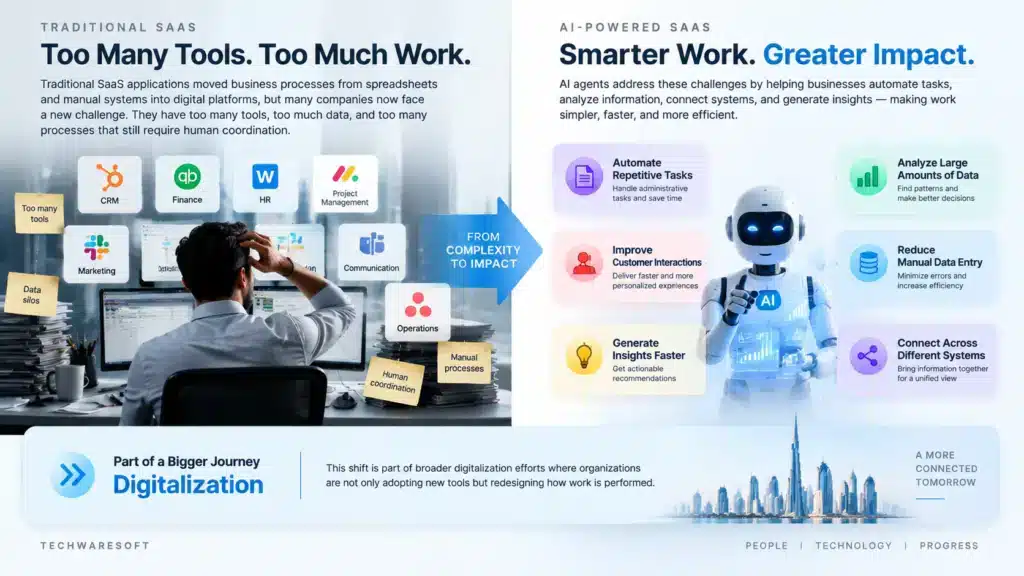
A successful AI transition often requires Modernization of existing technology environments.
This may include:
- Improving data quality
- Connecting different business systems
- Updating outdated applications
- Strengthening cybersecurity
- Creating better digital workflows
- Preparing infrastructure for AI adoption
AI agents are only as effective as the systems and information they can access.
The Future: Software That Works With People
The next stage of business technology will not simply be about replacing applications with AI. It will be about creating systems that understand business goals and help employees achieve them more efficiently.
Traditional SaaS platforms provide the structure businesses need. AI agents provide a more intelligent way to interact with that structure.
Companies that successfully combine both approaches can reduce operational friction, improve decision-making, and create better experiences for employees and customers.
Frequently Asked Questions
1. Are AI agents going to replace SaaS software?
AI agents are unlikely to completely replace SaaS platforms. Instead, they are expected to work alongside existing software by improving automation, analysis, and user interaction.
2. What is the difference between AI agents and traditional automation?
Traditional automation follows predefined rules and workflows. AI agents can interpret instructions, analyze information, and complete more flexible tasks based on context.
3. Why do businesses need AI development when SaaS platforms already exist?
SaaS platforms provide essential business functions, but AI development can help organizations create customized automation, intelligent assistants, and workflows that match their specific requirements.
4. How should companies prepare for AI-powered business software?
Businesses should focus on improving data quality, modernizing existing systems, connecting applications, and identifying processes where AI can create measurable improvements.

Working on something like this?
Tell us what you are building and who it is for. We will tell you what it takes.