
Blog
What Is the Ruby Programming Language Used For?
23 Oct 2026Techwaresoft3 min read

An online booking platform may look simple to its users. Customers select a time slot, confirm their reservation, and receive a notification. Behind those actions, software must check availability, process requests, and update records.
Ruby is one of the programming languages developers use to build that functionality.
Known for its readable syntax, Ruby supports web applications, backend development, automation, and system integrations. Although closely associated with Ruby on Rails, the language has uses beyond building websites.
What Is Ruby Programming Used For?
Ruby is an open-source, general-purpose programming language created by Yukihiro Matsumoto and publicly released in 1995.
Developers use Ruby to build applications, process information, and automate tasks. It supports object-oriented programming and reusable libraries called gems, allowing developers to extend applications without writing every component from scratch.
According to the official Ruby documentation, flexibility and programmer productivity are central to its design.
Common applications include:
- Web applications: Customer portals, booking systems, and SaaS platforms
- Backend development: Server-side logic and database operations
- Automation: Scheduled reports and repetitive administrative tasks
- API integrations: Communication between business applications
- Internal tools: Data processing utilities and reporting systems
Is Ruby Used for Frontend or Backend Development?
Ruby is primarily used for backend development, where it manages application logic, processes requests, and communicates with databases.
In web development, frontend technologies handle what users see and interact with, while backend technologies manage operations behind the interface.
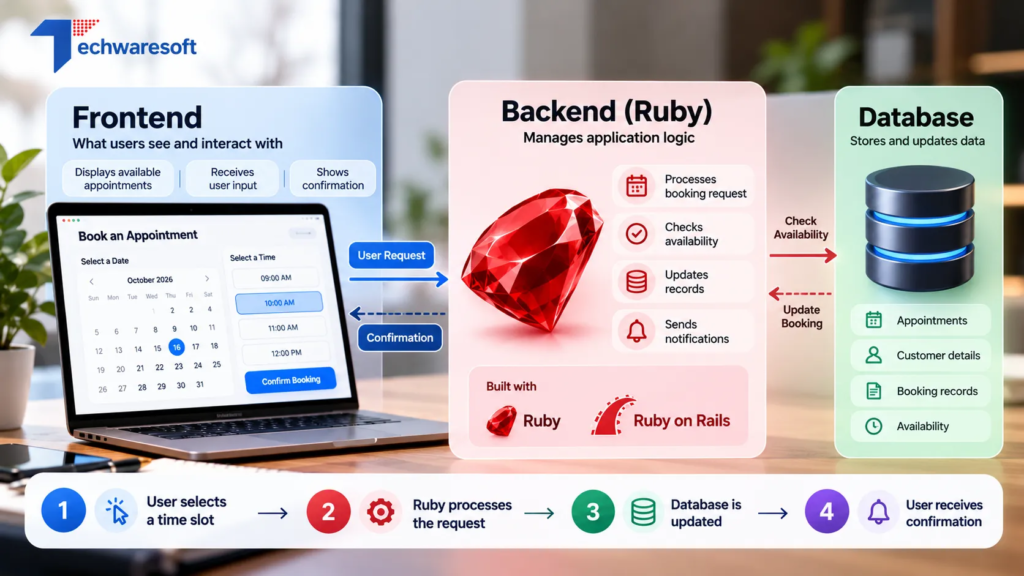
Consider an appointment booking system. The frontend displays available appointments. Ruby can process the booking request, check availability, and update the database.
Ruby is frequently used with Rails for these applications, although other frameworks are also available.
What Is the Difference Between Ruby and Ruby on Rails?
Ruby is a programming language, while Ruby on Rails is a web application framework built using Ruby.
Ruby provides the language’s core functionality. Rails adds established conventions and tools for developing database-backed web applications.
| Feature | Ruby | Ruby on Rails |
| Type | Programming language | Web application framework |
| Main purpose | General software development | Web application development |
| Common uses | Scripts, automation, APIs | SaaS platforms, portals, websites |
| Database support | Available through libraries | Includes Active Record |
| Dependency | Works independently | Requires Ruby |
| Structure | Developer-defined | Convention-based |
A straightforward automation script may only require Ruby. A customer portal with authentication, database records, and multiple user roles could benefit from Rails.
The official Ruby on Rails Guides explain how these components work together.
What Can Ruby Do Besides Web Development?
Ruby can process business information, connect applications, and support internal software tools.
For example, a finance department receiving daily transaction files from several branches could use a Ruby script to combine records, identify missing information, and prepare a consolidated report.
Ruby can also support API connections between CRM platforms, ERP systems, and customer-facing applications.
These capabilities make it useful for organizations that need software to handle repetitive operations or exchange information between existing systems.
Can Ruby Be Used for Automation?
Yes. Ruby can automate tasks involving files, scheduled operations, data processing, and communication with external services.
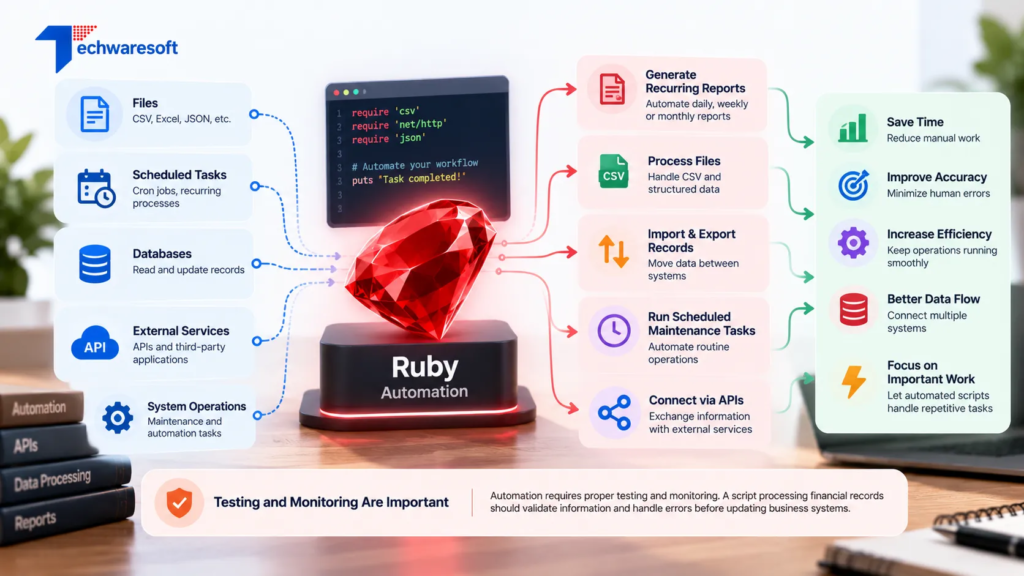
Developers commonly use it for:
- Generating recurring reports
- Processing CSV and structured files
- Importing and exporting records
- Running scheduled maintenance tasks
- Exchanging information through APIs
Automation still requires testing and monitoring. A script processing financial records, for instance, should validate information and handle errors before updating business systems.
Is Ruby Still Relevant in 2026?
Yes. Ruby remains an actively maintained programming language used in existing applications and new software projects, particularly within the Rails ecosystem.
However, its suitability depends on the technical requirements.
Businesses should consider application performance, database complexity, developer expertise, security, and future maintenance.
Ruby can support substantial web applications when the underlying architecture is properly designed. For specialized machine learning or scientific computing, other programming ecosystems may offer more extensive dedicated libraries.
When Should Businesses Choose Ruby for Software Development?
Ruby is worth evaluating when a project requires a custom web application, backend service, system integration, or automation tool.
A company developing a subscription platform, for example, may find Rails useful because of its established tools for managing databases and application workflows.
Before development begins, the team should establish:
- Required application features
- Expected user traffic
- Existing systems requiring integration
- Security and access requirements
- Maintenance responsibilities
For businesses developing customer portals, SaaS platforms, or custom web applications, Ruby on Rails development can support application development, system integrations and long-term maintenance requirements.
Selecting Ruby for the Right Application
Ruby remains a practical option for organizations developing custom applications or automating business processes.
Its value depends on the problem being solved and the technical environment supporting the application. Understanding those requirements helps businesses choose an appropriate development approach and avoid unnecessary complexity as their software evolves.



Working on something like this?
Tell us what you are building and who it is for. We will tell you what it takes.