
Ruby on Rails development, upgrades and support
New Rails applications built on the framework's conventions, older ones brought up to a supported version, and the codebase you already have taken over, tested and kept moving.
Rails development, upgrades, APIs and integrations, rescue and maintenance, and Rails developers who join your team — from a software company that ships what it builds.

Rails capabilities and services
What Ruby on Rails is, and when it fits
Ruby on Rails is an open-source, full-stack web framework written in Ruby. It gives an application its database layer, routing, views, background jobs, email and deployment tooling out of the box, so a small team spends its time on the product rather than the plumbing.

- What Rails is A framework that makes most of an application's routine decisions for you — where files go, how tables map to models, how URLs map to actions — so every Rails codebase looks broadly like every other one.
- Why convention matters Because Rails apps share a shape, a developer who has never seen yours can find their way around it quickly. That is what makes a Rails codebase cheaper to hand over, take over and staff than one built on house patterns.
- How Rails builds interfaces Hotwire is the default front end: pages rendered on the server and updated over the wire, without a separate JavaScript application. Where a product needs one — or a mobile app — Rails runs as the API behind it instead.
- Where it fits best Business applications, marketplaces, SaaS products, portals and internal tools: products with real data and real workflows, where moving quickly with a small team matters more than squeezing out the last millisecond.
Rails problems we solve
Six situations that bring teams to us about Rails — most of them about an application that already exists rather than one still to be written.
Stuck on an old Rails version
The application runs on a Rails or Ruby version that no longer gets security fixes, and every month it stays there the upgrade gets bigger.
The original developers have gone
The agency or freelancer who built it has moved on, nobody left knows how it fits together, and every change is made nervously.
Slow pages and timeouts
Pages that were fast with a hundred records crawl with a hundred thousand: N+1 queries, missing indexes and work done in the request that belongs in a background job.
No tests worth trusting
Coverage is thin or the suite has been failing for months, so nobody can tell whether a change broke something until a customer reports it.
Gems that block every update
Abandoned or pinned dependencies hold the whole application back, and updating one breaks three others.
A roadmap with nobody to build it
The product needs features, and hiring Rails developers locally is slow — so the backlog grows while the team stays the same size.
Our Ruby on Rails services
Five services covering a Rails application from its first commit to the years of maintenance after it.
Rails application development
New applications built on Rails, from first release through the features that follow.
Data modelling, Hotwire interfaces, background jobs, admin areas, authentication and roles, and tests written alongside the code.
Rails upgrades and migration
Older applications brought up to a supported Rails and Ruby version, one step at a time.
Version-by-version upgrades, dependency clean-up, deprecation fixes, and moves to Rails from another framework.
Rails APIs and integrations
Rails as the backend behind a React front end or a mobile app, and connected to the services around it.
REST and JSON APIs, API authentication, webhooks, and integrations with payment gateways, CRMs and third-party services.
Code audits and rescue
A straight assessment of an inherited codebase, then the fixes in order of risk.
Code, test and dependency review, security checks, performance profiling, and a written plan before feature work resumes.
Maintenance and Rails developers
Ongoing support for a live application, or Rails developers working inside your own team.
Bug fixes, security patches, monitoring, feature work on retainer, and dedicated developers on your stand-ups and repository.
What we work with in a Rails application
Twelve parts of the Rails stack across four layers. Most of it ships with the framework; the rest is what we add when a project needs it.
Application core
Where the data and the business rules live.
Active Record and PostgreSQL
Models, migrations, associations and queries, on PostgreSQL, MySQL or SQLite.
Background jobs
Email, imports, reports and slow work moved out of the request, with Active Job.
Authentication and roles
Sign-in, sessions, password resets and permissions, with the generator Rails 8 includes or a gem.
Front end and APIs
How people and other systems reach the application.
Hotwire
Turbo and Stimulus for fast, interactive pages without a separate JavaScript app.
JSON APIs
Rails as the backend for a React or Vue front end, a mobile app or a partner.
Admin interfaces
Internal screens for the team that runs the product: records, approvals and reports.
Quality and security
What makes it safe to change the code next month.
RSpec and Minitest
Model, request and system tests around the paths the business depends on.
Static analysis
RuboCop for consistency and Brakeman for common Rails security issues, run on every change.
Dependency hygiene
Gems audited and updated regularly rather than left until they block an upgrade.
Deployment and operations
Getting it live and keeping it healthy.
Kamal and Docker
Containerized deployments to your own servers or cloud, with the tooling Rails 8 ships with.
CI pipelines
Tests, linting and security checks on every pull request before anything reaches production.
Monitoring and performance
Error tracking, slow-query hunting, caching and indexes, measured before and after.
How a Rails engagement runs
Six stages, whether the application is new or inherited. For an existing codebase the first stage matters most: nobody should change code they have not read.
-
Discovery and code review
For a new build, what the application has to do and for whom. For an existing one, a review of the code, tests, dependencies and hosting before anything is touched.
-
Plan and estimate
Scope, sequence and cost written down: which features or fixes come first, and what each stage delivers. You approve it before work starts.
-
Safety net
Tests around the critical paths, CI on every change and a staging environment, so that everything after this point can be verified rather than hoped for.
-
Build or upgrade in increments
Short iterations with working software at the end of each, reviewed in pull requests. Upgrades go one Rails version at a time.
-
Release
Deployment through the pipeline, with a rollback ready, monitoring watching and a developer on hand while it settles.
-
Maintain and extend
Security patches, dependency updates and new features on an agreed rhythm, so the application never drifts back to where it started.
Why choose Techwaresoft for Rails?
Seven things that make a difference when you hand someone a Rails codebase — new or old.
Conventional Rails, not house patterns
We write Rails the way the framework intends, so the next developer — ours, yours or someone you hire later — can read it without a guide. That is what keeps a Rails application cheap to own.
Upgrades without a rewrite
We move old applications forward one version at a time instead of starting again.
Tests before changes
On inherited code we add tests around what matters before we change it.
A straight assessment
If Rails is the wrong choice for a project, or a rewrite really is cheaper, we say so.
Developers for your team
Rails developers can join your stand-ups and repository, not only work to a fixed scope.
More than the backend
Design, front end, DevOps and QA are in the same company as the Rails work.
Handover built in
Documentation and a walkthrough, so your own team can run what we built.
Trusted by







Working with systems that already exist
Not a Rails project: this case is a Bitrix24 and Odoo engagement for a Saudi workforce company. It is here because it is the same kind of work as a Rails rescue — two live systems nobody could read, fixed without throwing either away. A Rails case study will take its place once a client has approved one.
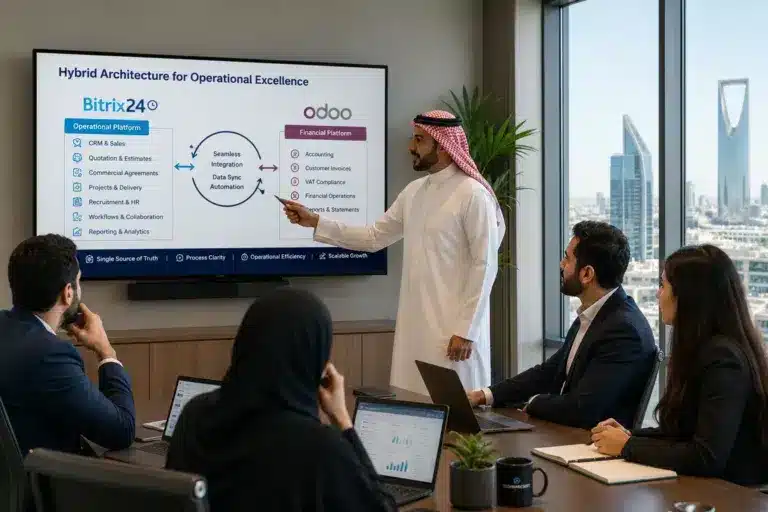
A hybrid Bitrix24 + Odoo architecture for a Saudi workforce company
- Challenge
- Bitrix24 and Odoo ran independently, with historical sales events and live agreements in the same records. Leadership could not read performance.
- Solution
- Neither system was replaced. We redesigned the operating model and governance, then split historical sales events from live agreements in a hybrid architecture.
- Result
- Reporting accuracy and accounting integrity preserved, recruitment and operational visibility improved, on an architecture that scales.
- Bitrix24
- Odoo
Industries we serve
Rails is a general-purpose framework, and it suits products that are mostly data and workflow. These are the sectors where that describes most of the software.

Technology & SaaS
Subscription products with accounts, plans, billing and an admin side — the kind of application Rails was built for.
Talk to us
Startups
A first version shipped by a small team, on a codebase the next developers can pick up without a rewrite.
Talk to us
Retail & Ecommerce
Custom storefronts, marketplaces and order back offices where an off-the-shelf platform has run out.
Talk to us
Finance & FinTech
Customer portals, onboarding flows and internal tools where the audit trail and the tests matter.
Talk to us
Real Estate
Listing, booking and tenant portals that tie properties, people and payments to one record.
Talk to us
Recruitment & HR
Job boards, applicant tracking and placement workflows with several roles working on the same data.
Talk to us
Education
Course, enrolment and learning platforms with student, teacher and admin views of the same content.
Talk to usWhat clients say about working with us
Clients on how the delivery went. None of the three is a Rails project — the first two are custom software and a platform build, the third is developers placed inside a client's team. A Rails testimonial will replace one once a client has approved it.
They built software that truly matched our needs. The team was responsive, detail oriented, and reliable, delivering solutions on time and ensuring the quality exceeded what we had hoped for.
Techwaresoft built a learning platform that is intuitive and engaging. The design makes learning drums enjoyable and straightforward, and their attention to user experience really stands out. Our students love the platform.
Techwaresoft's staff augmentation transformed our team. Their skilled professionals integrated seamlessly into our projects, bringing reliability, expertise, and efficiency. The team's proactive approach ensured our deadlines were met while elevating overall project quality.
Frequently asked questions
What teams ask before starting a Rails project or handing over an existing one. If yours is not here, it is quicker to ask.
Is Ruby on Rails still a sensible choice?
For business applications, marketplaces, SaaS products and internal tools, yes. The framework is actively maintained and releases regularly, and its conventions mean a small team spends less time on boilerplate. If your requirements point to something else, we will say so.
Can you take over an existing Rails application?
Yes. We start with a review of the code, test coverage, dependency versions and hosting, then give you a written assessment of what needs attention before new feature work begins.
How do you upgrade an old Rails version?
Incrementally, one Rails version at a time, leaning on the test suite. Where coverage is thin we add tests around the critical paths first, and we update the gems that block each step as we go, so the upgrade never turns into a guessing game.
Should we upgrade or rewrite?
Usually upgrade. A rewrite throws away years of fixed bugs and business rules that live only in the code. We recommend rebuilding only the parts where the review shows it is genuinely cheaper, and we tell you which those are.
Can Rails work with a React front end or a mobile app?
Yes. Rails runs well as an API behind React, Vue or a mobile app. For many business applications, though, Hotwire gives the same interactivity with one codebase instead of two, and we will recommend whichever fits the product.
Can we hire Rails developers to work in our team?
Yes. Developers can join your team through staff augmentation, working in your repository, tools and stand-ups, rather than to a fixed project scope.
How much does a Rails project cost?
It depends on scope, the state of any existing code and how much is already decided. We give a written estimate after discovery or a code review, not a figure before we have seen the work.
Will our team be able to maintain it after handover?
That is the intent. We follow Rails conventions rather than inventing our own, document what is not obvious and can work alongside your developers during the handover.
Get your Rails application moving again
Tell us what you want to build, or what state your current application is in. We will tell you what it takes — new build, upgrade, rescue or more developers — and in what order.
For an existing application, the most useful first step is read access to the repository: a review tells both of us more than any description can.