Blog
AI Agents vs Traditional Automation: What Should Businesses Use in 2026?
24 Sep 2026Techwaresoft6 min read
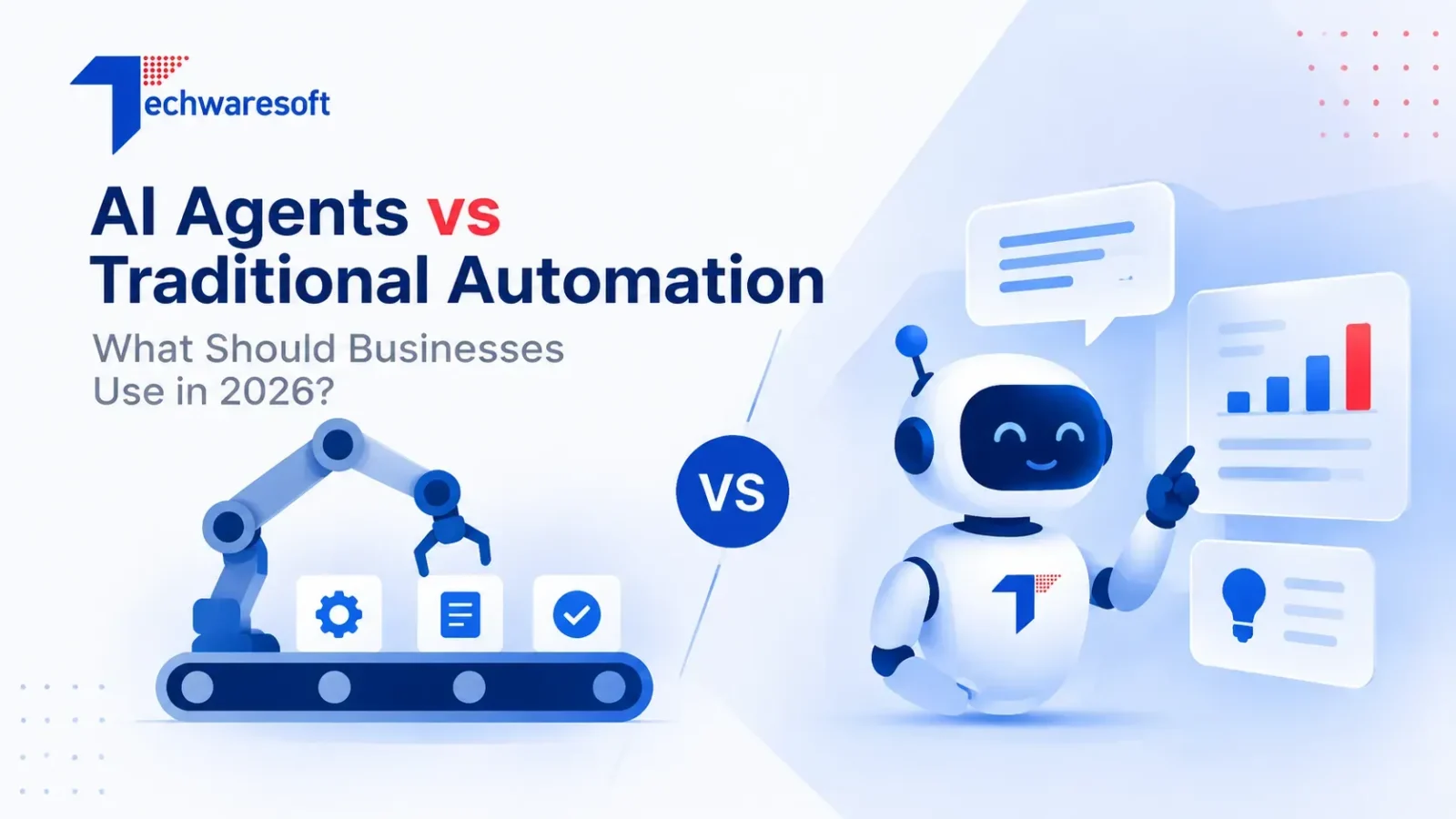
Automation has been helping businesses improve efficiency for years. Organizations use automated workflows to reduce repetitive work, improve accuracy, and create more consistent processes across departments. From customer notifications and invoice approvals to data synchronization and reporting, traditional automation has become an essential part of modern business operations.
However, the rise of AI agents is changing how companies think about automation.
Unlike traditional automation systems that follow predefined rules, AI agents can understand objectives, analyze information, make decisions within defined boundaries, and assist with complex workflows. This shift has created an important question for business leaders:
Should businesses continue investing in traditional automation, or should they adopt AI agent-based systems in 2026?
The answer depends on the type of process, business requirements, available data, security considerations, and the level of decision-making involved. In many cases, AI agents and traditional automation are not competing technologies. Instead, they can work together to create more intelligent, reliable, and scalable business operations.
Understanding Traditional Automation
Traditional automation works through predefined rules and workflows. Businesses define specific conditions, and the system performs actions based on those instructions.
For example:
- When a customer submits a form, send an automated confirmation email.
- When an invoice reaches a certain stage, notify the finance team.
- When inventory falls below a defined level, create a purchase request.
These workflows are highly effective because they provide consistency and predictable outcomes.
Common examples of traditional automation include:
- Workflow automation
- Robotic Process Automation (RPA)
- Scheduled reporting
- Data synchronization
- Email notifications
- Approval workflows
Traditional automation remains valuable because many business processes require reliability, accuracy, and repeatability.
What Are AI Agents?
AI agents represent a different approach to automation. Instead of only following fixed instructions, AI agents can understand goals, analyze information, and determine the steps needed to complete a task.
AI agents can:
- Understand natural language instructions
- Analyze business information
- Identify patterns and trends
- Recommend actions
- Complete multi-step workflows
- Interact with different business systems
For example, instead of manually creating a sales performance report, a manager could ask:
“Analyze this month’s sales performance, identify declining opportunities, and suggest actions for the sales team.”
An AI agent can review available information, summarize findings, and provide recommendations based on the request.
This creates a shift from software where employees manually operate every function toward systems where users define objectives and AI helps execute tasks.
AI Agents vs Traditional Automation
| Area | Traditional Automation | AI Agents |
| Decision-making | Follows predefined rules and workflows | Can analyze context and recommend actions |
| Flexibility | Best for predictable and repetitive processes | Handles changing situations and complex requests |
| User interaction | Requires users to configure workflows manually | Allows users to communicate through natural language |
| Data analysis | Processes structured information | Can interpret, summarize, and analyze information |
| Task complexity | Suitable for specific repetitive activities | Supports multi-step business processes |
| Human involvement | Employees create and manage workflows | Employees guide, review, and collaborate with AI |
AI agents are not replacing every function of business software. Instead, they are changing how employees interact with technology and how organizations automate work.
Where Traditional Automation Still Works Best
Despite the growth of AI agents, traditional automation continues to play an important role in business operations.
1. Processes With Clear Rules
Tasks with defined inputs and expected outcomes are usually better suited for traditional automation.
Examples include:
- Invoice approval workflows
- Employee onboarding processes
- Data transfers between systems
- Automated notifications
2. Processes Requiring Predictability
Businesses often need some workflows to execute exactly the same way every time. Rule-based automation provides reliability in these situations.
3. Compliance-Focused Processes
Industries with strict procedures, approvals, and audit requirements often benefit from automation systems that provide clear records of every action.
Traditional automation remains an important foundation even as organizations adopt newer AI technologies.
Where AI Agents Provide More Value
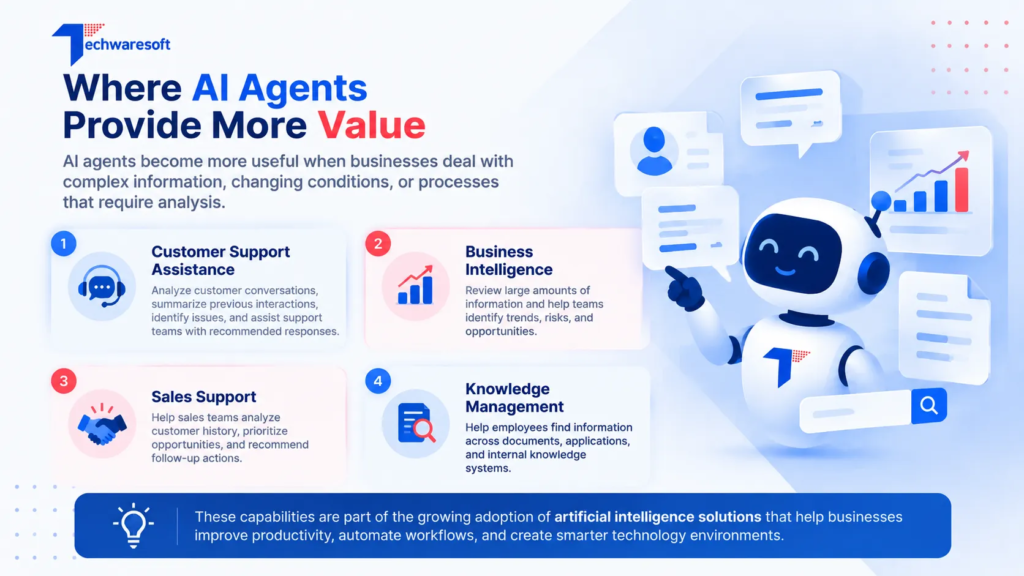
AI agents become more useful when businesses deal with complex information, changing conditions, or processes that require analysis.
Examples include:
1. Customer Support Assistance
AI agents can analyze customer conversations, summarize previous interactions, identify issues, and assist support teams with recommended responses.
2. Business Intelligence
AI agents can review large amounts of information and help teams identify trends, risks, and opportunities.
3. Sales Support
AI agents can help sales teams analyze customer history, prioritize opportunities, and recommend follow-up actions.
4. Knowledge Management
Organizations can use AI agents to help employees find information across documents, applications, and internal knowledge systems.
These capabilities are part of the growing adoption of artificial intelligence solutions that help businesses improve productivity, automate workflows, and create smarter technology environments.
Why Businesses Are Combining AI Agents With Automation
The future of business automation is unlikely to be a choice between traditional automation and AI agents.
A more practical approach is combining both technologies.
For example:
A traditional automation workflow can:
- Capture customer information
- Create records
- Assign tasks
- Trigger notifications
An AI agent can:
- Analyze the request
- Recommend priority levels
- Summarize information
- Suggest the next action
Together, they create a system where automation handles execution while AI supports intelligence and decision-making.
This approach allows businesses to improve efficiency without losing control over important processes.
Key Considerations Before Implementing AI Agents
Businesses should not introduce AI agents simply because the technology is available. Successful implementation requires proper planning and evaluation.
1. Data Quality
AI systems depend on accurate and accessible information. Poor-quality data can reduce the effectiveness of AI-driven processes.
Businesses should review:
- Data accuracy
- Data accessibility
- Information ownership
- System connectivity
2. Security and Privacy
AI agents often interact with business applications and sensitive information. Organizations need appropriate security controls to protect data and prevent unauthorized access.
Companies adopting AI-powered workflows should consider application security services to identify vulnerabilities, protect applications, and maintain secure technology environments.
3. Testing and Reliability
AI-powered systems require continuous evaluation to ensure they deliver accurate and reliable results.
Testing AI workflows, monitoring performance, and validating system behavior are important before deploying solutions at scale. Professional quality assurance services help businesses evaluate software quality, functionality, and reliability throughout development and deployment.
How Should Businesses Decide Between AI Agents and Automation?
The right approach depends on the business process.
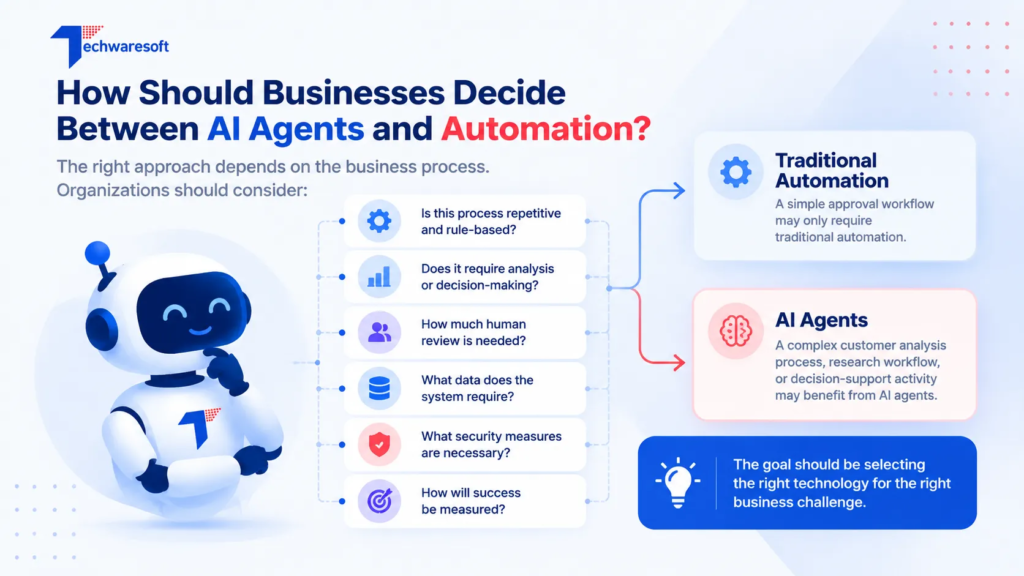
Organizations should consider:
- Is this process repetitive and rule-based?
- Does it require analysis or decision-making?
- How much human review is needed?
- What data does the system require?
- What security measures are necessary?
- How will success be measured?
A simple approval workflow may only require traditional automation.
A complex customer analysis process, research workflow, or decision-support activity may benefit from AI agents.
The goal should be selecting the right technology for the right business challenge.
Preparing for the Future of Intelligent Automation
In 2026, businesses are moving toward more intelligent technology environments where automation and AI work together.
Traditional automation provides structure, reliability, and control. AI agents introduce flexibility, analysis, and intelligent assistance.
Organizations do not need to replace every existing workflow with AI. A more effective approach is identifying areas where AI can create measurable improvements while maintaining security, quality, and human oversight.
Businesses that combine automation foundations with responsible AI adoption can create more efficient, scalable, and adaptable operations.
Building the Right Automation Strategy for 2026
The future of business automation is not about choosing between AI agents and traditional automation. It is about understanding where each technology creates the most value.
Traditional automation continues to provide dependable execution, while AI agents bring new capabilities for understanding, analysis, and intelligent assistance.
Businesses that combine automation, secure technology practices, reliable testing, and advanced AI solutions can build stronger digital foundations and create more efficient operations for the future.
Frequently Asked Questions
1. Are AI agents replacing traditional automation?
AI agents are not replacing all traditional automation. Rule-based automation remains valuable for predictable processes, while AI agents are better suited for tasks requiring analysis, flexibility, and decision support.
2. What is the main difference between AI agents and traditional automation?
Traditional automation follows predefined rules, while AI agents can understand goals, analyze information, and adapt their actions based on context.
3. Which business processes are best suited for AI agents?
AI agents are useful for processes involving customer support, data analysis, knowledge management, research, and decision support where flexibility is required.
4. Are AI agents secure for business use?
AI agents can be secure when implemented with proper access controls, data protection measures, monitoring, and application security practices.
5. Should businesses invest in AI agents or automation first?
Businesses should evaluate their current processes, technology environment, and goals. Many organizations benefit from improving automation foundations before introducing advanced AI capabilities.

Working on something like this?
Tell us what you are building and who it is for. We will tell you what it takes.