
Blog
Why Most CRM & ERP Implementations Fail Before They Even Begin
27 Nov 20266 min read

The Hidden Problem Isn’t the Software. It’s the Missing Business Rules.
When companies decide to implement a CRM or ERP system, the first question is usually:
“Which software should we choose?”
Should we use Odoo?
Should we use Bitrix24?
Should we use Focus Softnet?
Should we build something custom?
While these are important questions, they are often not the most important ones.
At Techwaresoft, we’ve learned that the success of a CRM or ERP implementation has very little to do with the software itself.
The real challenge is defining the business rules that the software will enforce.
A CRM Cannot Fix Unclear Business Processes
Imagine asking ten people in your company the following questions:
- When should a deal be marked as Won?
- How should recurring contracts be reported?
- Who owns an existing customer?
- Who should receive commission on renewals?
- How should referrals be handled?
- What happens if a client extends a contract?
- How should VAT affect sales reporting?
- Should passive recurring revenue count as new sales?
If you receive ten different answers, your CRM implementation will struggle regardless of the platform you choose.
The software can only automate what the business has already decided.
The Problem With “We’ll Figure It Out Later”
Many organizations postpone these decisions until after implementation.
Unfortunately, that usually leads to:
- Sales reports that nobody trusts
- Incorrect commission calculations
- Conflicts between salespeople
- Disputes about client ownership
- Poor management visibility
- Difficult board reporting
- Inaccurate forecasting
Eventually, management begins questioning the reports.
Then employees begin questioning the system.
Eventually, the CRM becomes a very expensive contact database.
The Questions Nobody Thinks About During CRM Implementation
Many of the most important CRM decisions don’t seem important until they start affecting reporting, commissions, employee evaluations, and business visibility.
For example:
When Is A Deal Actually Won?
Consider a staff augmentation contract.
The agreement is signed in December.
The resource starts work on January 1.
The invoice is issued at the end of January.
The client pays in March.
Should the deal be reported as won in:
- December?
- January?
- March?
There is no universally correct answer.
But if your company doesn’t define one, every manager may interpret it differently.
The result is inconsistent reporting and confusion regarding sales performance.
What Happens When A Project Grows?
Imagine a software project that begins as an $800 engagement.
The client likes the work.
Additional requirements are added.
The project grows into a $15,000 relationship.
Should the original deal be modified?
Should a new deal be created?
Should the increase be treated as an upsell?
Should it count as additional sales?
Again, there is no universally correct answer.
But there must be a documented answer.
What Happens When Multiple Employees Contribute To One Sale?
One employee secures an initial verbal agreement worth AED 3,000.
Another employee later expands the opportunity and closes it at AED 6,000.
Who should receive the sales credit?
- The first employee?
- The second employee?
- Both?
Without documented rules, the CRM quickly becomes a source of internal disputes instead of operational clarity.
How We Approach This At Techwaresoft
Before implementing any CRM or ERP system, we first try to document the business rules behind it.
The objective is not to create bureaucracy.
The objective is to ensure that everyone in the company interprets business events in the same way.
For example:
Sales Attribution
If a salesperson closes a recurring contract worth AED 1,000 per month:
How much sales credit should they receive?
- One month?
- Three months?
- Twelve months?
- The entire lifetime value?
There is no universally correct answer.
But there must be a documented answer.
Otherwise sales reports become meaningless.
Commissions
Should commissions be paid when:
- An invoice is issued?
- A payment is received?
- The project is completed?
Should Stripe processing fees affect commissions?
Should VAT be included?
Should recurring revenue be treated differently?
Again, there is no universally correct answer.
But there must be a consistent answer.
Renewals & Existing Customers
If a client continues a contract without any sales effort:
Should that be reported as a new sale?
Should the original salesperson receive additional credit?
Should management receive credit?
Should nobody receive additional credit?
Many companies unintentionally inflate their sales reporting because these questions were never addressed before the CRM was implemented.
Sales, Revenue and Collections Are Not The Same Thing
One of the most common reporting mistakes we see is treating sales, revenue, and collections as if they are the same metric.

They are not.
For example: Software Is Only The Last Step
A sales team may close a contract worth AED 60,000.
Revenue may be recognized gradually over twelve months.
Cash may be collected on a completely different timeline.
Each metric answers a different business question.
Sales
What business did we win?
Revenue
What value did we earn?
Collections
What money did we actually receive?
When businesses fail to separate these concepts, reporting becomes misleading and decision-making becomes significantly more difficult.
Why Reporting Matters
The purpose of a CRM is not simply to store data.
The purpose is to provide visibility.
Good reporting allows management to answer questions such as:
- How much new business did we win?
- How much recurring revenue do we have?
- How much revenue was earned?
- How much money was collected?
- Which salesperson performs best?
- Which marketing channels generate results?
- Which services are growing?
- Which clients generate the highest lifetime value?
When the underlying rules are unclear, reporting becomes unreliable.
And when reporting becomes unreliable, decision-making suffers.
A CRM Is Not Just A Database
Many organizations think a CRM is primarily a place to store:
- Leads
- Contacts
- Companies
- Deals
In reality, a CRM is a system for enforcing business decisions.
Every automation, dashboard, KPI, workflow, commission calculation, and management report depends on assumptions about how the business operates.
If those assumptions are unclear, the technology cannot compensate for it.
A CRM simply exposes inconsistencies that already exist within the business.
The Goal Is To Eliminate Grey Areas
One of our core operational philosophies at Techwaresoft is:
If a decision needs to be made twice, it should probably be documented.
Documentation creates consistency.
Consistency creates trust.
Trust creates adoption.
And adoption is what makes CRM and ERP projects successful.
Documentation Is A Competitive Advantage
Many companies view documentation as administrative overhead.
We view it differently.
Every recurring question represents a hidden operational cost.
Every repeated discussion represents uncertainty.
Every unclear process creates friction.
At Techwaresoft, we believe documented decisions eventually become:
- Policies
- Standard Operating Procedures (SOPs)
- Sales Playbooks
- Approval Frameworks
- Reporting Standards
- Automation Rules
- Knowledge Bases
Over time, this reduces dependency on individuals and increases organizational maturity.
The company becomes more scalable because knowledge becomes institutional rather than personal.
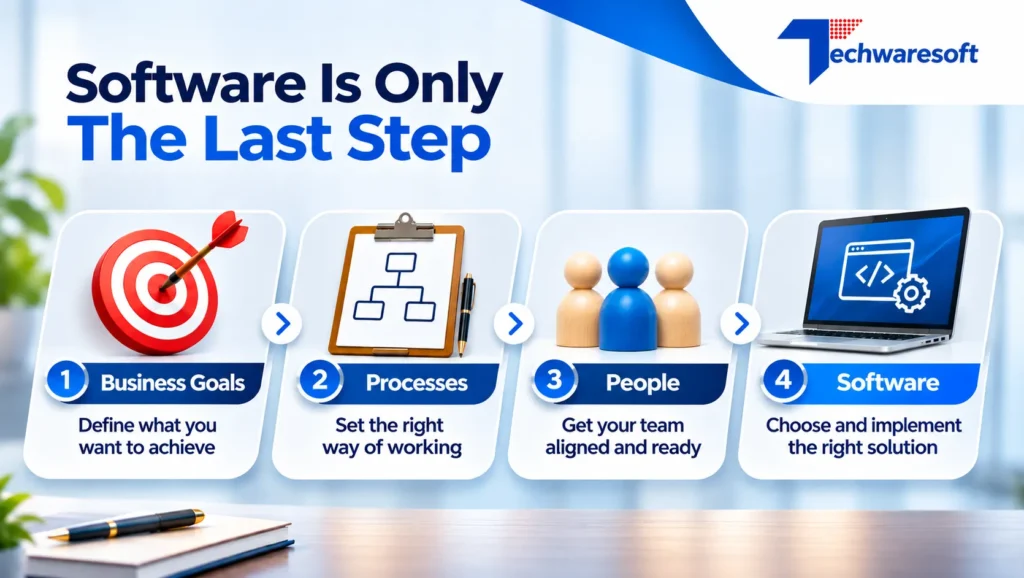
Software Is Only The Last Step
Once the business rules are defined, implementing them becomes much easier.
Whether the chosen platform is:
- Bitrix24
- Odoo
- Focus Softnet
- Salesforce
- HubSpot
- A custom-built solution
the implementation becomes a process of translating business decisions into software configuration.
The software becomes the tool.
The documented process becomes the system.
How Techwaresoft Can Help
Our approach goes beyond software setup.
We help organizations define the business rules that make software implementations successful.
Business Process Design
- Sales processes
- Lead management
- Approval workflows
- Escalation procedures
- Operational governance
Sales Governance & Reporting Design
- Sales attribution frameworks
- Commission structures
- Revenue reporting models
- Collections reporting
- KPI design
- Performance measurement
- CRM governance
CRM Implementation
- Bitrix24
- Odoo CRM
- Custom CRM solutions
ERP Implementation
- Odoo
- Focus Softnet
- Industry-specific ERP solutions
Reporting & Analytics
- Sales reporting
- Revenue reporting
- Collections reporting
- Executive dashboards
- Management reporting
- Business intelligence
Operational Documentation
- Process documentation
- SOP development
- Approval matrices
- Sales playbooks
- Knowledge base creation
- Policy design
Automation & Integrations
- Workflow automation
- Lead assignment
- Notifications
- Approvals
- System integrations
- Custom business logic
Final Thoughts
Many companies believe they have a software problem.
In reality, they often have a process definition problem.
The software simply exposes it.
Before implementing a CRM or ERP system, ask yourself:
Have we clearly defined how our business should operate?
If the answer is no, that is usually the best place to start.
Because the most successful implementations are not built on software.
They are built on clarity.
And clarity begins with documentation.
Need Help Designing Your Processes Before Implementing Software?
Techwaresoft helps businesses across the UAE, GCC, UK, and North America design and implement scalable systems using Bitrix24, Odoo, Focus Softnet, and custom software solutions.
Whether you’re implementing a CRM, ERP, sales process, commission structure, reporting framework, or business automation initiative, we can help you define the rules before the software is configured.
Because successful digital transformation starts with clear business processes—not software licenses.


Working on something like this?
Tell us what you are building and who it is for. We will tell you what it takes.